Review
Velotric Ebike Review 2026: Discover 3 and Fold 1 Plus Against the Commuter Market
By Ruben Marsh · Staff writer · Reviewed by Miles Mercer
Last updated
The verdict
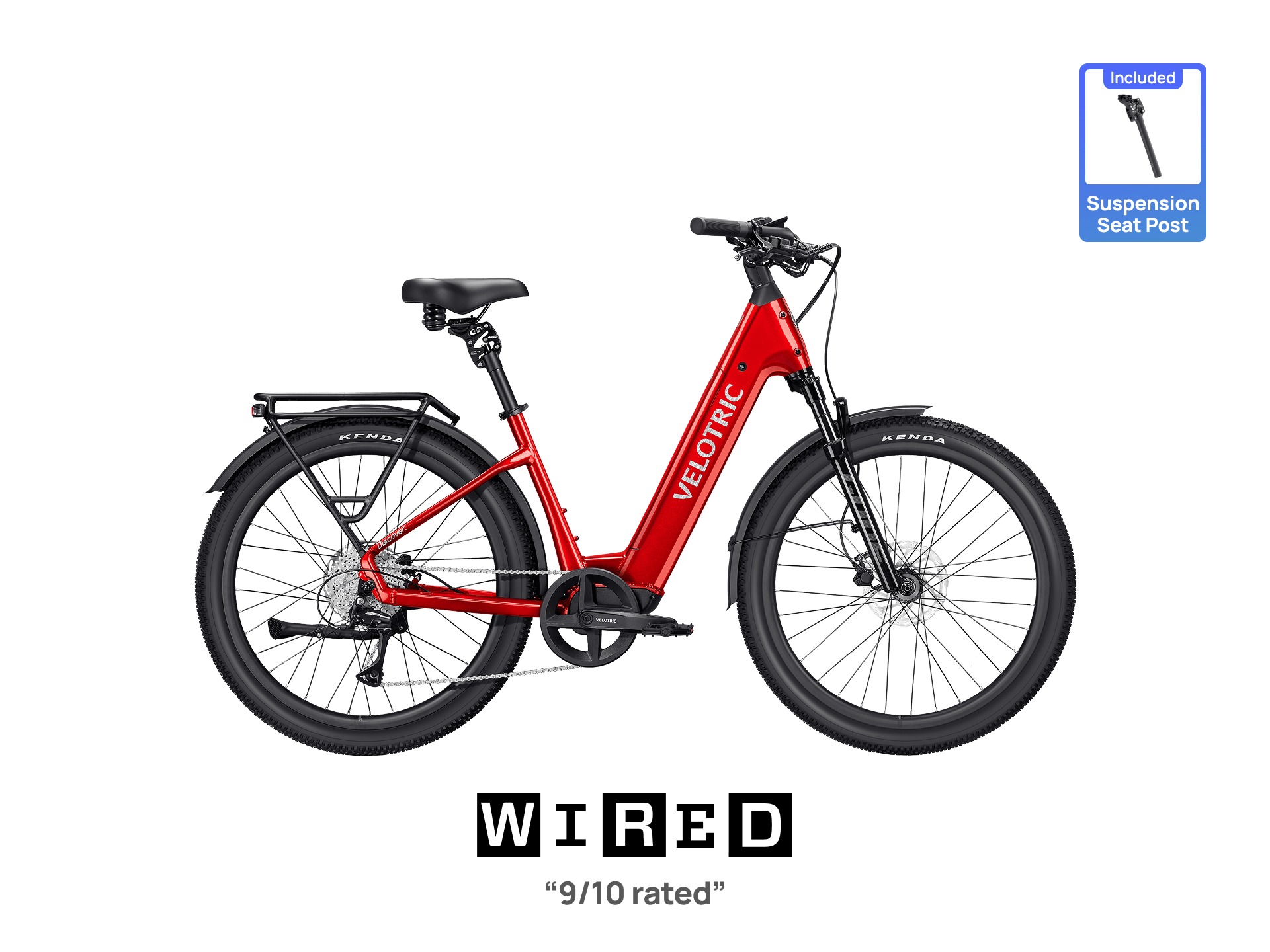
Velotric Discover 3 Commuter
from
$1999
Next-gen comfort commuter with 750W motor delivering smooth assistance for daily commuting and longer rides with extended battery range.
Best for: Commuters seeking comfort and reliability on varied terrain and longer distances without sacrifice.
$1999 · Check priceWhat we like
- + Exceptional comfort with ComfortMax™ ergonomic design and air suspension fork
- + Extended range and responsive motor for commuting or weekend rides
- + Integrated smart features including Apple Find My and dual torque/cadence sensing
Worth noting
- – Step-through frame only may not suit all riders
- – Hub motor not ideal for technical trails
We earn commissions from links on this page, at no cost to you. Our picks stay independent. Prices are indicative and were last checked around publication — they change often, so confirm the current price on the retailer’s site. How we research & rank →
At a glance
How they compare
| Spec | Top pickVelotric Discover 3 Commuter | Velotric Fold 1 Plus Folding |
|---|---|---|
| Price | $1999 | $1399 |
| Motor | 750W hub (1100W peak), 75Nm torque | 750W hub (1050W peak), 70Nm torque |
| Range | Up to 80 miles | Up to 55 miles |
| Weight | Approx 57 lbs | Approx 48 lbs |
| Battery | 730Wh Samsung/LG 21700 | 608Wh removable |
| Check price → | Check price → |
Velotric has built its lineup around loading real hardware — torque sensors, suspension forks, app connectivity — into commuter e-bikes priced below the premium tier. Electricbikereview.com, which tracks Velotric as a brand and reviews its models regularly, has covered the company’s lineup expansion and feature updates over multiple release cycles. Electric Bike Report and Forbes have separately reviewed Velotric’s Breeze 1 model, both describing a company that iterates quickly on features rather than resting on a single flagship design. The Discover 3 and Fold 1 Plus are two commuter-focused models built for people riding to work, to the store, or around town rather than off-road or on serious climbs.
Who the Velotric Discover 3 is for
The Discover 3 is a step-through commuter built for comfort and range. According to Velotric’s published specifications, it runs a 750W hub motor with 1100W peak output and 75Nm of torque, paired with a 730Wh Samsung/LG 21700 battery rated for up to 80 miles of range. That’s a large capacity pack for a commuter in this price bracket, and the torque figure is high for a hub-driven system, which typically favors smooth, proportional assistance over the on/off feel of cheaper cadence-only setups.
Real-world range on any e-bike depends heavily on rider weight, terrain, assist level, and temperature, so the 80-mile figure should be read as a best-case number under light-assist, flat-terrain conditions rather than a guarantee. At about 57 lbs, the Discover 3 also carries some weight, which is typical for a battery this size but worth factoring in if you’ll be lifting it onto a rack or up stairs regularly.
The bike’s suspension fork and ergonomic frame design target pavement and light gravel comfort rather than technical terrain. The Discover 3 is only offered as a step-through frame, which is a plus for easy mounting and a wider range of rider heights, but riders who specifically prefer a step-over or diamond frame for stiffness or aesthetics don’t have that option on this model.
Who the Velotric Fold 1 Plus is for
The Fold 1 Plus solves a narrower, more specific problem: storage. Its folded footprint of 37.8 inches long, 19.7 inches wide, and 33.5 inches high, combined with a roughly 48 lb weight, makes it a realistic option for apartment dwellers, train commuters, or anyone who needs to stash a bike in a car trunk or closet — something the full-size Discover 3 can’t offer.
Its standout feature is dual sensor switching, letting riders toggle between cadence and torque sensing depending on the ride. Torque sensing generally delivers a more proportional, natural pedaling feel that scales with rider effort, which suits longer rides where smoothness and efficiency matter. Cadence sensing tends to deliver a more immediate, point-and-go boost that some riders prefer for short errands or stop-and-go city riding, even though it can feel less graduated. Having both available on one bike is a genuine differentiator, since many commuter e-bikes in this range lock riders into one sensor type.
Specs on the Fold 1 Plus include a 750W motor with 1050W peak, 70Nm of torque, and a 608Wh removable battery rated for up to 55 miles. That’s meaningfully less range and battery capacity than the Discover 3, which is the direct trade-off for portability. The folding hinge itself is also a mechanical compromise worth acknowledging: any folding joint is a moving part that a rigid frame doesn’t have, and folding bikes in general are worth test-riding or researching carefully for fit, since geometry and wheel size often differ from full-size commuters.
Where these bikes fall short
A few limitations apply to both models, and they’re not unique to Velotric — they’re inherent to hub-motor, lithium-ion commuter e-bikes as a category.
- Hub motors aren’t built for hills or trails. Both the Discover 3 and Fold 1 Plus use hub motors. Really Good EBikes and Upway, in their respective comparisons of hub versus mid-drive systems, both note that hub motors are simpler and cheaper to maintain but deliver less efficient power transfer on steep or technical terrain than mid-drive systems. If your commute involves serious climbs, that’s a real limitation to weigh before buying either bike.
- Cold weather reduces range. GreenMoov’s guide to e-bike battery lifespan notes that lithium-ion batteries lose meaningful capacity in cold conditions, since chemical reactions inside the cells slow down as temperature drops. Riders in colder climates should expect the Discover 3’s 80-mile claim and the Fold 1 Plus’s 55-mile claim to shrink in winter, sometimes substantially, and should plan charging and route length accordingly.
- Battery degradation is a long-term cost. GreenMoov’s research indicates typical e-bike batteries last 500 to 1,000 charge cycles, translating to roughly 3 to 5 years under average use, with premium cell packs reaching 5 to 7 years. Ariel Rider’s guide on e-bike battery lifespan puts eventual replacement cost in a wide range depending on voltage and capacity. Neither Discover 3 nor Fold 1 Plus escapes this; it’s a cost to plan for a few years down the line rather than a defect.
- Step-through-only limits Discover 3 buyers. Riders who want a step-over frame for stiffness, standover clearance, or aesthetic preference don’t have that option on this model.
None of this makes either bike a bad purchase. The marketing numbers on range and battery life are ceiling figures, not guarantees, and buyers should plan around real-world conditions rather than spec-sheet peaks.
How the category around Velotric works
The direct-to-consumer e-bike market has grown fast — Grand View Research’s U.S. e-bike market report and MarketsandMarkets’ Electric Bike Market Report both project continued strong growth in the segment through the next decade, which means more brands entering at similar price points with similar-looking spec sheets. That makes differentiation harder to judge from marketing copy alone. Motor wattage and torque numbers are a starting point, but frame geometry, battery chemistry, sensor type, and after-sale support matter just as much for how a bike actually rides and holds up over years of use.
Safety certification is one area worth checking regardless of brand. UL 2849 testing, which UL’s own certification page describes as covering electrical system safety for e-bikes, is voluntary at the federal level in the US according to the Federal Register’s 2024 advance notice of proposed rulemaking on electric bicycles. Some jurisdictions have moved to require it locally due to battery fire risk, so confirming certification status is a reasonable step before buying any e-bike, Velotric included.
Bottom line
The Discover 3 makes sense if comfort, range, and daily-commute reliability matter most and a step-through frame isn’t a dealbreaker. The Fold 1 Plus makes sense if storage space or portability is the binding constraint and the sensor-switching flexibility appeals. Neither is the right choice for serious hill climbing or off-road riding — both rely on hub motors, and a mid-drive system will generally outperform a hub motor on steep or technical terrain regardless of how well the rest of the bike is tuned. Buyers should treat the published range and torque figures as best-case numbers, verify UL 2849 certification status where it’s legally required, and budget for battery replacement as a normal cost of ownership a few years in rather than a surprise.
Frequently asked questions
What’s the difference between the Velotric Discover 3 and Fold 1 Plus?
The Discover 3 is a full-size step-through commuter with a larger 730Wh battery, up to 80 miles of rated range, a 750W motor (1100W peak), and 75Nm of torque. The Fold 1 Plus trades range (up to 55 miles) and battery size (608Wh) for a folding frame that collapses to about 37.8 x 19.7 x 33.5 inches and weighs roughly 48 lbs, making it the better pick if storage or transit portability matters more than maximum range.
Do Velotric e-bikes need UL certification to be legal in the US?
UL certification (UL 2849) is voluntary at the federal level in the US, according to the Federal Register’s 2024 advance notice of proposed rulemaking on electric bicycles, but some local jurisdictions have moved toward requiring it due to battery fire safety concerns. Buyers should confirm current certification requirements in their specific city or state before purchasing any e-bike, including Velotric models.
How long will a Velotric battery last before it needs replacing?
typteries generally last 500 to 1,000 charge cycles, or about 3 to 5 years under average use, according to GreenMoov’s research on e-bike battery lifespan, with premium cell packs reaching 5 to 7 years. Ariel Rider’s guide on battery longevity notes replacement cost varies depending on voltage and capacity, so it’s worth budgeting for as a longer-term ownership cost rather than assuming the original pack lasts indefinitely.“}],
Why do both Velotric models use hub motors instead of mid-drive?
Hub motors are simpler, cheaper to maintain, and common in commuter e-bikes at this price point. Really Good EBikes and Upway, comparing hub and mid-drive systems, both note that hub motors deliver less efficient power on steep or technical terrain than mid-drive systems, which is why Velotric’s Discover 3 and Fold 1 Plus suit flat-to-moderate commuting routes better than hilly or off-road use.
Keep reading
- Fat tire ebike
- Commuter electric bike
- Electric utility bike
- Electric bike
- Electric bike for adults
- Electric mountain bike for adults
- Aventon soltera ebike
- Aventon aventure 2 ebike
Sources
- U.S. E-bike Market Size, Share And Trends Report, 2030
- Electric Bike Market Report 2026-2035
- E-Bike Battery Lifespan: Complete Guide to Cycles, Factors, and Maximizing Longevity
- How Long Does An Ebike Battery Last?
- E-Bike Motors Compared: Hub vs. Mid-Drive
- E-Bike Motor Types: Hub vs. Mid-Drive Comparison
- Global E-Bike Safety Standards Comparison: International Regulations Guide 2025
- Electric Bicycles; Advance Notice of Proposed Rulemaking
- E-Bikes Certification: Evaluating and Testing to UL 2849
- Velotric Reviews
- Velotric Breeze 1 Review | Light Frame, Big Power and Pure Fun
- Ride Review: Velotric Breeze 1 Ebike (Forbes)
Specifications
| Motor | 750W hub (1100W peak), 75Nm torque |
|---|---|
| Range | Up to 80 miles |
| Weight | Approx 57 lbs |
| Battery | 730Wh Samsung/LG 21700 |
| TopSpeed | 28 mph (Class 3) |
Alternatives
Other options worth comparing
Lectric XPeak Off-Road Trail Bike
Best for riders seeking an affordable, versatile fat tire eBike with solid range and responsive motor control.
Aventon Aventure All-Terrain Adventure Bike
Best for riders wanting modern smart features, GPS security, and smooth torque-sensor power on varied terrain.
Aipas M2 Pro Full-Suspension Off-Road Bike
Best for off-road riders and budget-conscious buyers wanting dual suspension and strong climbing power.